- Dettagli
- Scritto da Barbara de Munari
- Visite: 1943

Chers sociétaires, chers amis,
Nous reprenons le cycle de notre Lectura Dantis, le :
Vendredi 24 avril 2026, à 16 heures 30
Bibliothèque interuniversitaire de la Sorbonne
Salle de formation
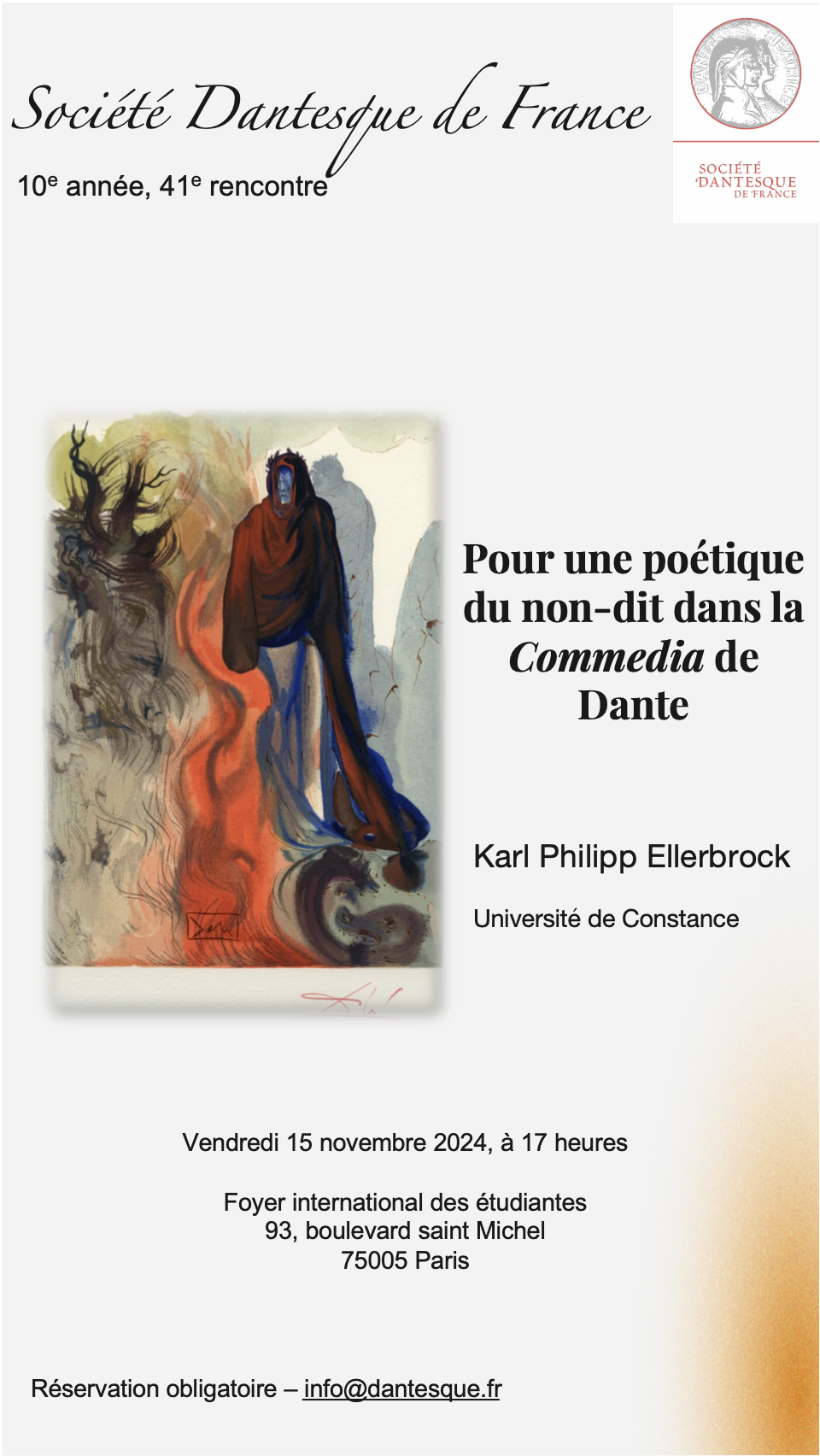
Christian Trottmann, du Centre d’Études Supérieures de la Renaissance, présentera sa lecture du chant XI de l’Enfer ; comme précisé sur l’affiche illustrée par le dessin William Blake en reconstruisant la structure morale de l’Enfer.
Si vous ne possédez la carte de la BIS, merci de vous inscrire par retour de courriel, ou en écrivant à l’adresse suivante : Questo indirizzo email è protetto dagli spambots. È necessario abilitare JavaScript per vederlo.
En espérant vous retrouver nombreux,
Cordialement,
SDdF
- Dettagli
- Scritto da Barbara de Munari
- Visite: 9954

Chers sociétaires, chers amis,
Poursuivant nos travaux, nous pouvons annoncer que la prochaine rencontre de la Société Dantesque de France se tiendra le :
Vendredi 20 mars 2026, à 16 heures 30
Bibliothèque interuniversitaire de la Sorbonne
Salle de formation
Pierre Bouretz, de l’EHESS, présentera une communication intitulée « Une saison avec Dante ». L’affiche est en pièce jointe. Si vous ne possédez la carte de la BIS, merci de vous inscrire par retour de courriel, ou en écrivant à l’adresse suivante : Questo indirizzo email è protetto dagli spambots. È necessario abilitare JavaScript per vederlo.
En espérant vous retrouver nombreux,
Cordialement,
SDdF

Pierre Bouretz est un philosophe français né le 24 novembre 1958 à Lille.Il est directeur d'études à l’École des hautes études en sciences sociales (EHESS) à Paris, où il est rattaché au Centre des savoirs sur le politique. Recherches et analyses (CESPRA – CNRS/EHESS). Il a également été membre du Centre d'études interdisciplinaires des faits religieux (CEIFR) et a exercé des responsabilités éditoriales, notamment comme co-directeur de la revue Esprit pendant plusieurs années.
Domaines de spécialisation
Ses travaux portent principalement sur :
- la philosophie allemande (Kant, Hegel, Cohen, Habermas, etc.),
- le messianisme et ses liens avec la philosophie et la religion,
- la pensée juive moderne (en particulier Hermann Cohen),
- les rapports entre philosophie, religion et politique,
- la question de la raison face à la foi et au sécularisme.
Principaux ouvrages
Parmi ses publications les plus connues :
- Témoins du futur. Philosophie et messianisme (Gallimard, 2003) – un ouvrage de référence sur le messianisme juif et ses échos philosophiques,
- Qu'appelle-t-on philosopher ?,
- La raison ou les dieux,
- Sur Dante (Gallimard, 2023) – essai philosophique récent où il propose une lecture originale de La Divine Comédie de Dante, en insistant sur sa dimension politique, poétique et transgressive pour l’époque médiévale.
Il est régulièrement invité à intervenir sur ces thèmes, y compris dans des cycles prestigieux comme le Cycle Marc Bloch à l’EHESS (conférence « Démons et merveilles » en 2025).
Dans le contexte de la Société Dantesque de France, son intervention prévue le 20 mars 2026 à la Bibliothèque interuniversitaire de la Sorbonne s’inscrit logiquement dans sa réflexion récente sur Dante, qu’il aborde avant tout comme philosophe plutôt que comme pur spécialiste de littérature médiévale.
*********
Hermann Cohen (1842–1918) stands as one of the most influential philosophers of the late 19th and early 20th centuries. He founded the Marburg School of Neo-Kantianism, which dominated German academic philosophy until World War I, and is widely regarded as the most important Jewish philosopher of the 19th century. His thought evolved from rigorous reinterpretations of Kant into a comprehensive “system of philosophy” grounded in pure reason, before culminating in a distinctive “religion of reason” drawn from Jewish sources. Cohen’s philosophy emphasizes anti-psychologism, the constructive power of pure thinking, ethical idealism, and a messianic vision of universal human progress.
plato.stanford.edu
jewishstudies.washington.edu
3-16am.co.uk
Biography and Intellectual Context
Born on July 4, 1842, in Coswig (Anhalt), Germany, to a devout Jewish family—his father was a synagogue cantor—Cohen initially trained for the rabbinate at the Jewish Theological Seminary in Breslau. He shifted to secular philosophy, studying at universities in Breslau, Berlin, and Halle (Ph.D. 1865). Influenced by Adolf Trendelenburg and Heymann Steinthal, he turned decisively to Kant. In 1873 he became a Privatdozent at the University of Marburg; by 1876 he was full professor—a rare achievement for an unconverted Jew in Bismarck’s Germany. He faced anti-Semitism (e.g., from historian Heinrich von Treitschke), to which he responded publicly in his 1880 “Declaration on the Jewish Question.” Cohen taught at Marburg until retiring in 1912, then moved to Berlin to lecture on Jewish philosophy at the Academy for the Science of Judaism until his death on April 4, 1918.
en.wikipedia.org +1
His career divides into three phases:
- Early Kant commentaries (1870s–1880s).
- Mature systematic philosophy (1902–1912).
- Late religious writings (1915–1919, the last posthumous).
Interpretation of Kant and the Marburg School Cohen’s breakthrough came with Kant’s Theory of Experience (1871; 2nd ed. 1885). He rescued Kant from psychologistic misreadings (e.g., those reducing a priori forms to subjective mental structures) and from metaphysical ones. For Cohen, Kant’s critical philosophy investigates the transcendental conditions that make objective experience (especially mathematical natural science) possible. The “fact of science” is the starting point; philosophy articulates its a priori principles.
plato.stanford.edu
This anti-psychologism—rejecting any reduction of logic or ethics to empirical psychology—became the hallmark of the Marburg School (with students like Paul Natorp and Ernst Cassirer). Cohen introduced the “principle of the infinitesimal method” (1883), arguing that the infinitesimal calculus exemplifies how pure thinking generates continuity and objectivity without relying on “given” sensations. He rejected Kant’s independent “thing-in-itself” and sensible intuition as ultimate; instead, thinking itself originates the laws of nature.
The System of Philosophy (1902–1912)Cohen’s three-part System presents critical idealism in its purest form:
- Logic of Pure Knowledge (1902): Knowledge arises from “pure thinking” alone—no sensations, no external “given.” Thinking generates principles through judgment forms (origin, identity, contradiction, etc.). The infinitesimal is paradigmatic: “the triumph of pure thinking.” Objects of science are constituted by these logical laws, ensuring objectivity without psychologism.
- Ethics of Pure Will (1904): Ethics begins not with individual psychology but with the “fact” of pure jurisprudence—universal laws governing human action. The moral subject is humanity as a whole; the ideal is a “realm of ends” realized through democratic institutions, universal suffrage, and worker collectives. Cohen’s Kantian ethics thus grounds a non-Marxist democratic socialism: treating people as ends prohibits labor exploitation.
- Aesthetics of Pure Feeling (1912): Pure feeling is the consciousness of consciousness—the awareness that we experience the lawful objects of science and ethics. It produces the objects of art and links aesthetics to religion (especially through lyric poetry).
A planned fourth part on psychology of cultural consciousness remained unwritten. Throughout, Cohen used a historical “problemgeschichte” method: philosophy reconstructs the evolution of concepts to reveal their rational necessity.
plato.stanford.edu
Philosophy of Religion and Judaism: The Late Turn
After 1912, Cohen’s focus shifted. In Berlin he immersed himself in Jewish sources, producing The Concept of Religion in the System of Philosophy (1915) and the monumental Religion of Reason Out of the Sources of Judaism (posthumous, 1919). Religion does not replace ethics or philosophy but complements them. Ethics deals with the abstract “I” as member of humanity; religion addresses the concrete individual “Thou”—the suffering person, sin, repentance, and atonement.
Central innovation: the correlation between God and humanity. God is not a metaphysical entity but the unique ethical ideal that guarantees the possibility of moral progress. Humanity discovers itself through sin and atonement; God is the “guarantor” of the correlation. Judaism provides the original sources of “religion of reason”: strict monotheism (one God for all humanity) and prophetic messianism—the hope for the “dominion of the good on earth,” a future ethical community without national or political boundaries.
plato.stanford.edu
Cohen rejected Zionism (e.g., in debates with Martin Buber), viewing it as a regression into history; Judaism’s mission is universal and spiritual, best fulfilled in diaspora. He championed German-Jewish symbiosis and ethical socialism. In his words, love of God is knowledge of the ultimate moral purpose of mankind.
Key Innovations and Themes
- Pure thinking as originative, not receptive.
- Anti-psychologism as defense of philosophy’s autonomy.
- Infinitesimal method linking mathematics, logic, and reality.
- Ethical monotheism and messianism as rational hope.
- Reconciliation of reason and faith: Judaism as the purest “religion of reason.”
Influence and Legacy
Cohen shaped 20th-century thought profoundly. In general philosophy, his transcendental method influenced Cassirer’s philosophy of symbolic forms, phenomenology, and even logical positivism. In Jewish philosophy, he inspired Martin Buber’s dialogical “I-Thou,” Franz Rosenzweig, and Emmanuel Levinas. His messianic optimism—radical hope amid crisis—continues to resonate (e.g., in Pierre Bouretz’s studies of messianism). Today, scholars revisit Cohen for his integration of ethics, politics, and religion, his critique of nationalism, and his vision of perpetual ethical progress.
brandeis.edu
Cohen’s philosophy invites us to see reason not as cold abstraction but as the creative force behind science, morality, art, and the hope for a just world. Exploring his works—especially the Ethics of Pure Will and Religion of Reason—reveals a thinker who never separated rigorous critique from profound ethical and religious commitment. For primary reading, the 2021 English anthology Hermann Cohen: Writings on Neo-Kantianism and Jewish Philosophy is an excellent starting point.
- Dettagli
- Scritto da Barbara de Munari
- Visite: 13471

Chers sociétaires, chers amis,
Le séminaire Dante et la philosophie reprend ses travaux. Conformément à l’affiche ci-jointe, je vous invite à nous retrouver pour la première séance le
Mardi 20 janvier 2026, à 17h
à l'École Normale Supérieure, salle Cavaillès
Le sujet de cette année est :
Rivières de sang chez Dante (Inf. XII, 47)
La Commedia comme histoire du sang
Et voici le programme :
- 20 janvier : Du sang et des larmes : Inf. III, 67-68 ; Inf. V, 90 ; Inf. VI, 65 ; XIV, 76-81.
- 24 février : Le sang du cœur : Vita nuova, II, 4 ; III, 4
- 24 mars : Le sang des lignages ; l'« alto sangue » et la « schiatta » : Convivio, IV, IV, 10 ; IV, XX, 5 ; XXIX, 3 ; Inf. XXIX, 22.
- 21 avril : Le sang de l'histoire : Inf. XXVIII, 1-21.
- 26 mai : Rencontre internationale : Valeurs culturelles franco-chinoises et Humanisme global (avec le concours de la Beijing Normal University et de la Jingshi Academy)
Ces premières rencontres seront poursuivies, aux prochains semestres, par l’approche du sang dans le Purgatoire et dans le Paradis.
Après l'évocation de la figure de Joachim de Flore (2023) et l'étude des Formes substantielles (2024-2025), je me réjouis de poursuivre avec vous l'exploration des voies ouvertes par Dante dans la mémoire européenne.
En attente de vous retrouver nombreux,
Bien cordialement
Bruno Pinchard
https://x.com/i/grok/share/c3037d9aaca14818a60d7b357cfd488b
- Il post annuncia la ripresa del seminario "Dante et la philosophie" della Société Dantesca de France, con la prima sessione del 20 gennaio 2026 dedicata al tema "La Commedia comme histoire du sang", esplorando fiumi di sangue nell'Inferno dantesco (es. Inf. XII, 47).
- Barbara de Munari, presidente di ETICA Edizioni e figura centrale della società, condivide l'evento per promuovere studi su Dante, influenzando la memoria europea attraverso analisi filosofiche e culturali.
- L'immagine allegata è un poster illustrato con un dipinto di Delacroix ("Lac de sang hanté des mauvais anges"), che rafforza il tema simbolico del sangue come elemento narrativo e storico nella Commedia.
- Dettagli
- Scritto da Barbara de Munari
- Visite: 1656
Chers sociétaires, chers amis,
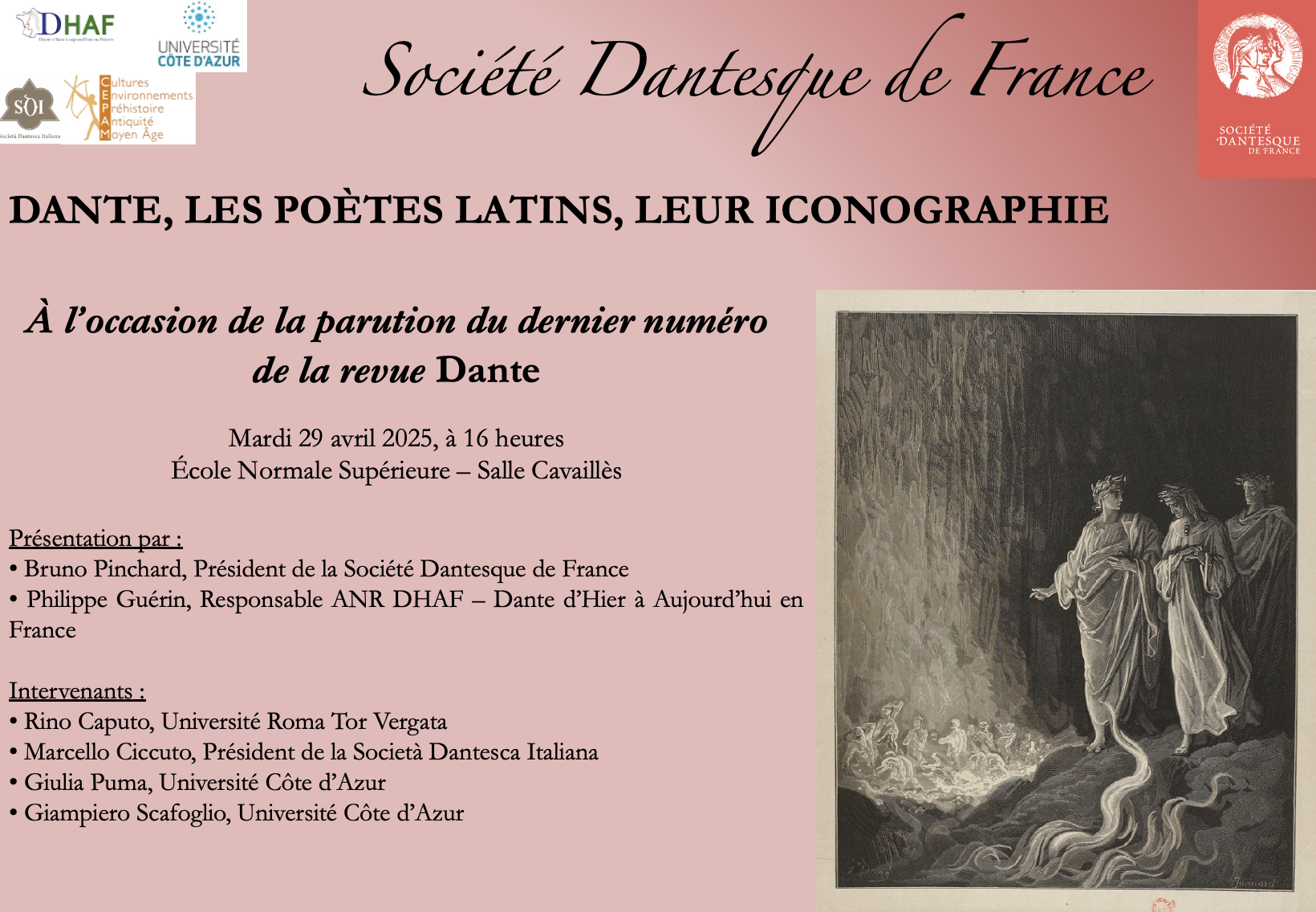
Nous vous communiquons l’annonce du colloque international « Dante en France : la réception savante », organisé dans le cadre du projet ANR « Dante d’hier à aujourd’hui en France », du 19 au 23 mai 2025, sur différents sites. Nous attirons votre attention sur la nécessité de vous inscrire pour la séance du 20 mai à l’Istituto Italiano di cultura di Parigi, ainsi que pour le concert prévu le même jour en début de soirée.
Enfin nous vous signalons tout particulièrement la conférence de madame Françoise Graziani, de la Société Dantesque de France, vendredi soir, en clôture du colloque, sur le thème : « Une lectura dantis en images : l’Enfer peint à la fin du xve siècle dans la chapelle Saint-Thomas de Pastoreccia (Corse) ».
Cordialement,
SDdF
https://www.facebook.com/photo?fbid=9925968267493401&set=pcb.9925980690825492
- Dettagli
- Scritto da Barbara de Munari
- Visite: 6218
Chers sociétaires, chers amis de la Société Dantesque de France
Reprenons nos travaux en 2026. 2025 a été riche en événements dantesques dans notre cercle comme hors les murs. Dante est d'ailleurs fait pour outrepasser tous les murs. Nous le suivons pour cette raison, au risque de notre propre naufrage, nous le savons. Perpétuons, cette année encore, cette antique tradition qui, jusqu'ici, nous a valu tant d'heureuses lumières. Vous recevrez notre programme au plus vite.
Le Président.
Bruno Pinchard
Référence du tableau : Paul-Émile Sautai, Le Dante exilé, 1880, Musée de Rouen
Cari membri e amici della Società Dantesca di Francia,
Riprendiamo il nostro lavoro nel 2026.
Il 2025 è stato ricco di eventi danteschi, sia all'interno della nostra cerchia sia altrove. Dante, dopotutto, è destinato a trascendere ogni confine. Lo seguiamo per questo motivo, a rischio della nostra stessa rovina, come sappiamo. Perpetuiamo, anche quest'anno, questa antica tradizione che, finora, ci ha portato tanta illuminazione.
Riceverete il nostro programma il prima possibile.
Il Presidente,
Bruno Pinchard
- Dettagli
- Scritto da Barbara de Munari
- Visite: 18412
Chers sociétaires, chers amis,
En supplément de l’annonce du colloque international « Dante en France : la réception savante », moment des plus importants pour comprendre ce que nous devons au Sommo poeta, nous vous informons de la parution du numéro n°8 de notre Revue des études dantesques.
Vous trouverez en pièce jointe la couverture, la table des matières et le bon de commande.
Cordialement,
SDdF
https://www.facebook.com/photo?fbid=9925998304157064&set=pcb.9926009734155921
Pagina 1 di 13